
July 2nd, 2026, by Tracy L. Moore
It’s been said that the Statue of Liberty was a birthday gift to the United States from the people of France in 1886 to celebrate American independence from the British (1776) as well as to celebrate the friendship between both countries.
However, DID YOU KNOW that it was so much more than that? Though the Statue has become a SYMBOL of welcoming immigrants, that is not the reason why she was sculpted.
The gift was initiated out of the bondage of slavery, not immigration.
“The French political thinker, U.S. Constitution expert, and abolitionist, Edouard Laboulaye, was an honorary member of the Philadelphia branch (founded in 1862) of the Union League Club. The Union league Club was a group of people who were dedicated to the new Republican Party, the Union’s cause in the Civil War, and the abolition of slavery. Additionally, Laboulaye was a cofounder and president of the French Anti-Slavery Society. This society was founded in 1865. In essence, it called upon all nations to abolish slavery. Additionally, the members also raised money that was then given to newly freed slaves in the United States.”
Laboulaye hoped that with the abolition of slavery and the Union’s victory in the Civil War in 1865, the French people would embrace democracy in the face of monarchy, and break free from all forms of oppression.
Discrimination and racism did not end after the Civil War nor after the statue’s dedication, but continued for more than a hundred years. “Liberty and justice for all” were distant realities for African Americans. These were ironies against the backdrop of a nation’s claim of being a just and free society for all regardless of race. The Statue was a source of pain and struggles of the Negro’s plight: free but not free, separate but still not equal. How do they embrace the Statue as a beacon of hope when they were not fully included as citizens? That was a daily dilemma.
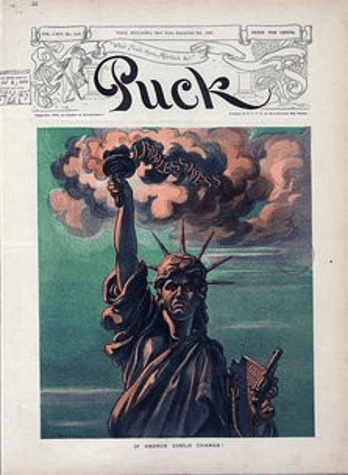
On September 9, 1908, the Puck Magazine published a likeness of the Statue of Liberty to portray the emotional weight and horrors that African Americans experienced after the Civil War. The caricature was titled “If bronze could change!” The Statue is clearly unhappy, due to the social unrest of the country at that time, with issues of “crime, vigilantism and mob rule”. In her right hand, she is holding the torch above her head with billowing black smoke that is labeled Lawlessness. In her left hand she is holding a rope labeled Lynching, a handgun and a tablet titled The Unwritten Law.
How frightening it is that these are some of the same issues this nation is still facing in 2026!
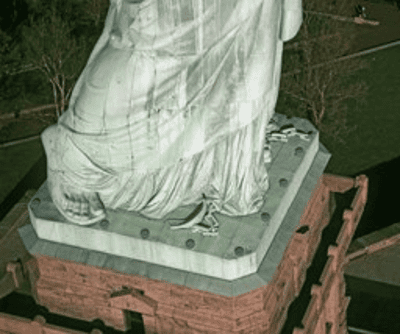
One more thing: take a look at the feet of the statue. Even in plain sight, most people don’t see the broken shackle and the chain at Lady Liberty’s left foot. In fact, though the shackle is broken, the truth was that freedom and democracy were not yet a reality for African Americans in 1886. It was not until 2017 that the public started to pay attention as well as during the movements of the 2020 Black Lives Matter and Juneteenth 2021.
W.E.B. Du Bois wrote in his autobiography, “The Autobiography of W.E.B. Du Bois: A Soliloquy on Viewing My Life From the Last Decade of Its First Century”, he wrote that as he sailed past the Statue on a return trip from Europe, he could not imagine the same type of hope that immigrant arrivals may have felt. That hope “did not pertain to his race. The fight for equality, liberty, and justice for all at that point in time had not been achieved, but rather disregarded after the Statue’s completion and dedication”.
So, African Americans were reluctant to embrace the symbol of a nation which would not fully include them as citizens.
Nonetheless, we keep Hope alive, for our families, especially for the generations not yet born.
Thanks for some of the information I found, and I give credit: https://www.nps.gov/stli/learn/historyculture/abolition.htm